

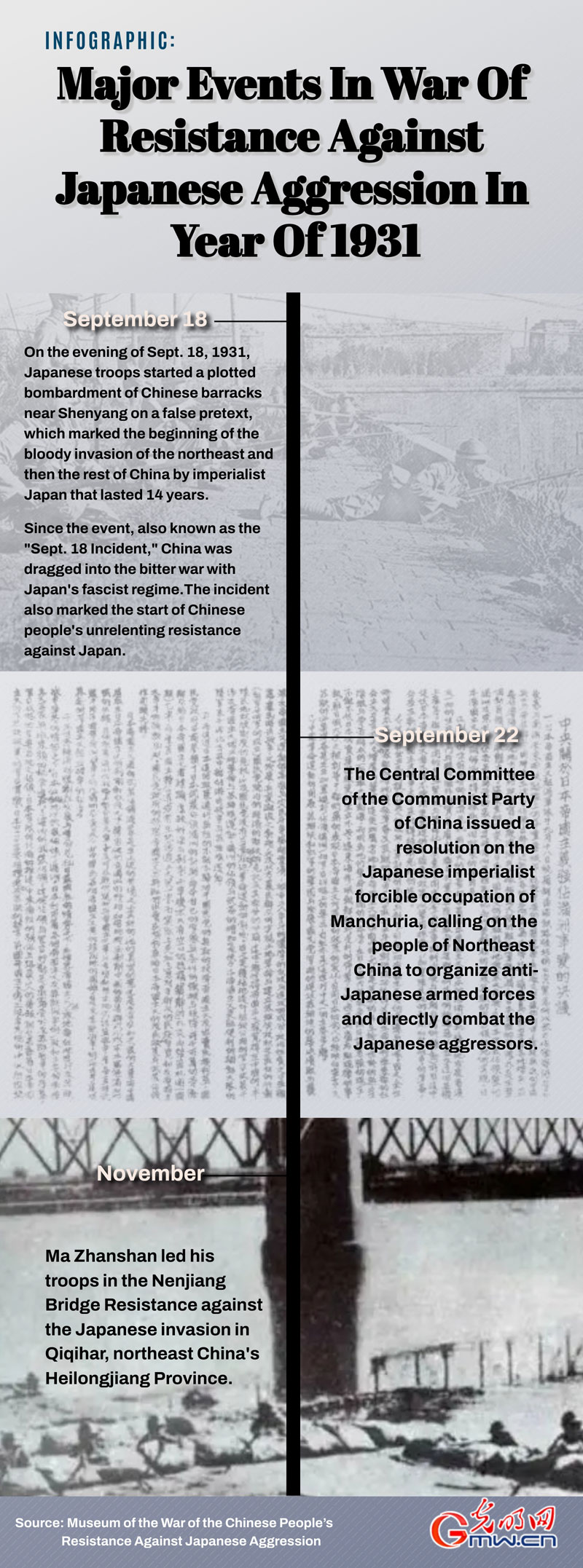
On the evening of Sept. 18, 1931, Japanese troops started a plotted bombardment of Chinese barracks near Shenyang on a false pretext, which marked the beginning of the bloody invasion of the northeast and then the rest of China by imperialist Japan that lasted 14 years.
Since the event, also known as the "Sept. 18 Incident," China was dragged into the bitter war with Japan's fascist regime. The incident also marked the start of Chinese people's unrelenting resistance against Japan, which formed an important part of the world people's fight against fascists during the Second World War.
On September 22, 1931, the Central Committee of the Communist Party of China issued a resolution on the Japanese imperialist forcible occupation of Manchuria, calling on the people of Northeast China to organize anti-Japanese armed forces and directly combat the Japanese aggressors.
In November of 1931, Ma Zhanshan led his troops in the Nenjiang Bridge Resistance against the Japanese invasion in Qiqihar, Heilongjiang Province.
点击右上角 微信好友
微信好友
 朋友圈
朋友圈

请使用浏览器分享功能进行分享