

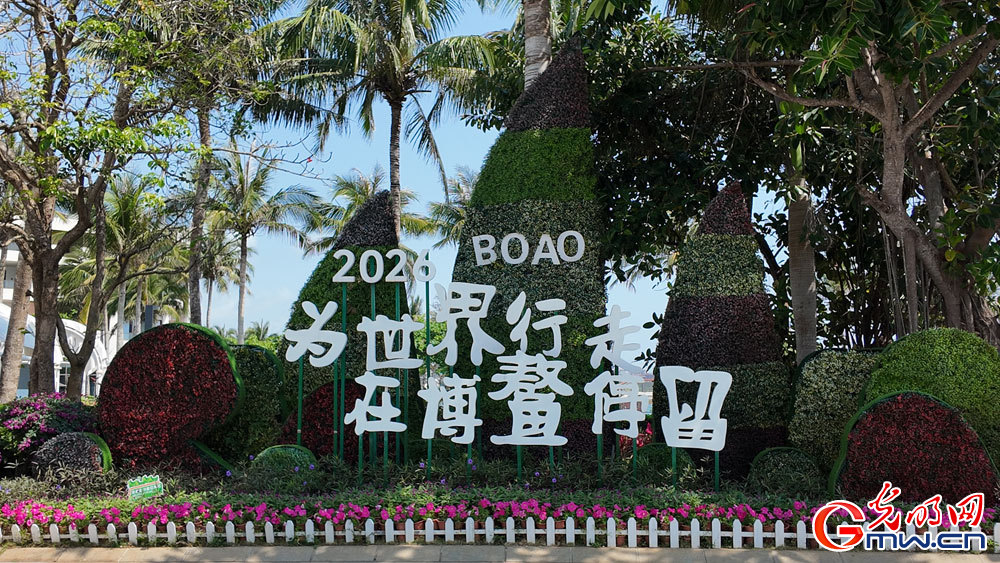
Photo taken on March 24, 2026 shows the exterior view of the venue of the Boao Forum for Asia (BFA) Annual Conference 2026 in Boao Town, Qionghai City, south China's Hainan Province. (Ruan Ziyan/Guangming Picture)
On March 27, the Boao Forum for Asia (BFA) Annual Conference 2026 came to a successful conclusion. Against the backdrop of headwinds confronting multilateralism and economic globalization, and a shaken international economic order, this annual conference was committed to strengthening the Asia-Pacific partnership, pursuing common development, and deepening regional cooperation and economic integration among Asian countries. It also injected impetus to China’s efforts to advance high-level opening-up.
Asia Has Become the Most Dynamic Region in the World
According to the 2026 “Annual Report on Asia's Economic Outlook and Integration Process” by the BFA, the economic growth rate of Asia in 2026 will reach 4.5%, confirming Asia remains the world economy’s key growth engine. The share of Asian economies' GDP in the global economy will keep rising, projected to climb from 49.2% in 2025 to 49.7% in 2026.
In recent years, the international situation has been fraught with turmoil and disorder, as unilateralism and protectionism continue to spread. Yet the Asian economy has maintained an upward trend with a promising prospect. It has become the most favored region by global direct investment capital and the world’s most promising and resilient region for development. Since 2010, the majority of developing economies in Asia have sustained economic growth above 4%, and many have even exceeded 5%. Asia accounts for more than 50% of global manufacturing value-added, which has also formed a coordinated development network for industrial and supply chains including mechanical electronics and new energy vehicles.
Why is the Asian economy able to outshine others and thrive vigorously? The first reason lies in its vast market. Asia has a population of over 4 billion, with a high proportion of young people. This massive domestic demand market not only provides a stable absorbing channel for regional production capacity, but also drives industrial upgrading and technological progress through consumption upgrading. The second reason is its strong innovation ability. Emerging industries across the region have boosted supply efficiency and created new growth spaces. The complete supply chain system allows Asia to respond rapidly to global technological transformation, and turn technological innovations into large-scale effective supply. The third reason is its reasonable regional policy coordination mechanism. Mechanisms such as the Regional Comprehensive Economic Partnership (RCEP) and the China-ASEAN Free Trade Area help to reduce costs for trade and cross-border investment, creating conditions for the integration of regional industrial chains. Therefore, Asian enterprises can allocate resources across countries at lower transaction costs, and transform scattered production processes across economies into closely linked ones.
This year marks the 25th anniversary of the founding of the BFA. Over the past 25 years, the forum has built consensus across Asia, and continuously facilitated forging a future-oriented shared vision for Asian countries and all sectors of society, including safeguarding multilateralism, strengthening regional cooperation, upholding innovation-driven concept, and advocating dialogues and exchanges. The forum has also effectively promoted cooperation among countries. It has always focused on real-world issues ranging from digital economy and artificial intelligence to sustainable development and green transformation, turning shared consensus into targeted policy dialogues and practical cooperation, which is of great significance for fostering a more inclusive and balanced form of economic globalization.
Economic and Trades Ties Among Asian Countries Tightened
According to the 2026 “Annual Report on Asia's Economic Outlook and Integration Process”, among the 22 core products in Asia’s regional value chains, China holds a leading position in 19 of them, and its strengths are mainly reflected in cost control, industrial agglomeration and supply chain collaboration capacity. As a matter of fact, Asia, especially East Asia, has become the heart of global value chains, while China serves as the heart of Asia’s regional value chains. Intermediate goods trade embodies a country's role in the international division of labor and its participation level in the global value chain. The more developed a country’s trade in intermediate goods is, the closer its upstream and downstream industrial ties with other economies, the wider its engagement in the international division of labor, and the deeper its integration into global value chains. Currently, Asia accounts for more than 40% of global trade in intermediate goods, while the European Union (EU) and North America represent approximately 25% and 15% respectively. Within Asia, China’s share of intermediate goods trade has overtaken that of North America since 2017, and its importance in the global industrial chain are regarded increasingly outstanding.
Economic and trade ties between China and other Asian countries are also getting tightened. Since 2020, ASEAN has overtaken the EU and the US as China’s biggest trading partner. In 2025, the total trade volume between China and ASEAN surpassed the $1 trillion threshold for the first time, rising by 7.4% year-on-year. In addition, China accounts for more than 30% of the Asian region’s trade in value-added. After the RCEP took effect, China’s key position in the Asian supply chains has been further reinforced through mechanisms including rules of origin accumulation and tariff exemptions.
The reason why China remains at the center of Asia’s regional value chains lies in its contribution to Asia’s overall development. In recent years, a comprehensive high value-added regional supply chain has been gradually formed in Asia. From cutting-edge chip manufacturing to packaging and testing, and from key electronic components to complete server manufacturing, Asia—bolstered by its comprehensive industrial chain system—has successfully transformed itself from the traditional “world factory” into a global high-end manufacturing hub. China’s contributions to Asia’s development are prominent. It not only maintains its advantages in mid-to-low-end manufacturing, but also steadily enhances competitiveness in high-tech fields such as electronics, mechanical equipment, lithium batteries and electric vehicles, driving the upstream global value chain. Meanwhile, investment in AI hardware and data infrastructure is developing at an unprecedented speed, and the development achievements brings obvious spillover effects, continuously injecting strong momentum into Asia’s industrial upgrading.
China and Asia Embracing Higher-Standard Opening-Up
In 2001, 26 Asia-Pacific countries including China adopted the “Boao Forum for Asia Declaration”, marking the official establishment of BFA. It is fair to say that the BFA was set up to address crisis and enhance Asia-Pacific cooperation, and the spirit of “pull together in times of trouble” was deeply rooted in its genes. Twenty-five years later, Asian countries—with China as the representative—have created a path of high-quality development through steadily opening up. In a world filled with uncertainties, China’s commitment to institutional opening-up has guided the direction of global economic development and injected certainty into the world economy.
This year’s Boao Forum for Asia Annual Conference falls on the 100- day milestone of Hainan Free Trade Port’s(Hainan FTP) customs closure operation. As China’s highest-level form of opening-up, the Hainan FTP’s customs closure symbolizes China’s opening-up have entered a new historical phase. Against the backdrop of Hainan FTP’s launch, this year’s conference carries special exemplary significance: it not only showcases to the world China’s firm determination to expand opening-up, but also provides new opportunities for Asian nations to deepen economic and trade cooperation.
China’s development has shown that openness brings progress, and cooperation creates the future. Amid a shifting global landscape, China adheres to expanding high-standard opening-up and strengthening implementation of regional strategies, which not only lays an institutional foundation for its own development, but also contributes China’s strength to the coordinated development of Asia.
Over the past 25 years, the BFA has spurred fresh vitality and witnessed a new starting point of China’s opening-up. Looking ahead, China will continue to deepen cooperation for mutual benefits and win-win outcomes, steadily expanding institutional opening-up. It will share development opportunities with all nations and pursue common prosperity for all.
Contributed by Wang Xiaosong, Researcher of Research Center for Xi Jinping Thought on Socialism with Chinese Characteristics for a New Era, Professor of School of Economics, Renmin University of China
Translated by Zhang Xijin
点击右上角 微信好友
微信好友
 朋友圈
朋友圈

请使用浏览器分享功能进行分享