


BEIJING, June 1 (Guangming Online) – The 5th CHINADA International Anti-Doping Symposium & iNADO Workshop took place in Beijing on Monday. Organized by the China Anti-Doping Agency (CHINADA) in partnership with the Institute of National Anti-Doping Organizations (iNADO), the symposium, themed “From Standards to Operations,” focused on three key areas: paperless testing, Doping Control Officers (DCO) management, and pre-event education. It provided a platform for anti-doping organizations from around the world to share practical tools and resources, exchange experiences, and explore innovative approaches to anti-doping governance.
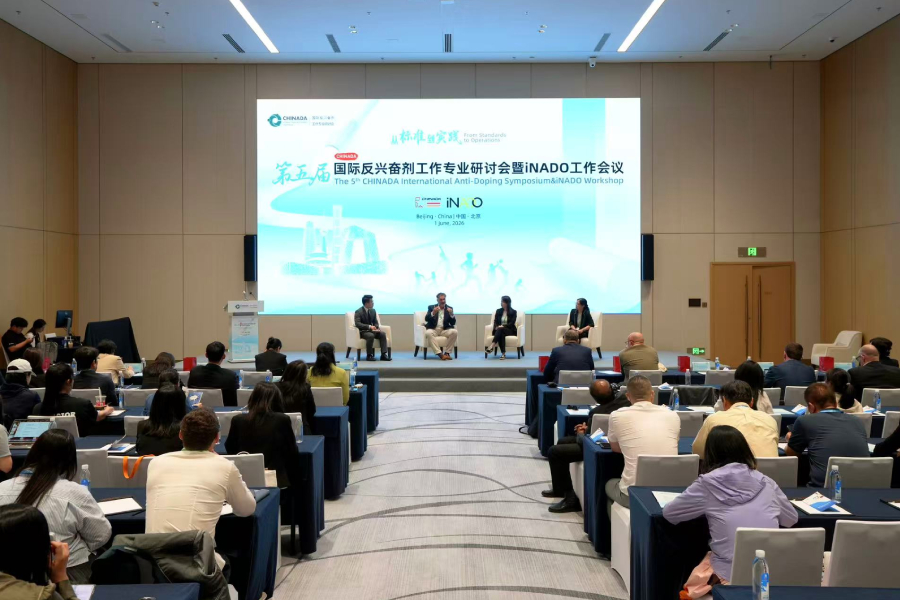
Representatives from across the globe gather to exchange ideas at the 5th CHINADA International Anti-Doping Symposium & iNADO Workshop on June 1 in Beijing. (Photo provided to Guangming Online)
“National Anti-Doping Organizations (NADOs) are doing more than two-thirds of the testing worldwide. We, as NADOs, are the heart of the anti-doping community,” emphasized Anders Solheim, Chairperson of iNADO, in his speech. He highlighted that NADOs are the core force of the global anti-doping system, praised CHINADA’s more than 30 years of professional practice, and called on colleagues worldwide to strengthen collaboration and enhance capacity to safeguard the independence and professionalism of the anti-doping movement.
“None of us can do this alone - it takes joint effort across countries and regions,” said Li Zhiquan, Director General of CHINADA. He stressed that CHINADA has always valued international exchange and cooperation, and hopes the symposium will further promote experience sharing and capacity building among national and regional anti-doping organizations.
Focusing on digital transformation: exploring innovative paperless testing practice
With the acceleration of digital transformation, paperless sample collection platforms are reshaping anti-doping workflows. Experts from Kazakhstan, PWC (a Sample Collection company), and China shared their experiences from the perspectives of DCOs, digital platform development, and paperless testing practices in large multi-sport events.
CHINADA expert Jin Yanjie introduced the newly developed next-generation paperless sample collection system, AIMS 2.0, based on experience from major events. The system has already been implemented in large-scale competitions such as the 15th National Games and the 6th Asian Beach Games. During the National Games, the system processed more than 3,000 tests, with a single-day peak of over 200 tests across more than 40 sports. At the 6th Asian Beach Games, the system delivered seamless data integration with the International Testing Agency (ITA), with 100% data upload accuracy and positive feedback from DCOs. Jin noted that looking ahead, CHINADA plans to provide a turnkey solution and contribute to the global anti-doping effort by supporting the modernization of doping control worldwide.
Strengthening team development: enhancing DCO management
DCOs play a critical frontline role in anti-doping efforts. The quality and fairness of testing largely depend on their professional competence and compliance. Experts from KADA (Korea Anti-Doping Agency), SARADO (South Asian Regional Anti-Doping Organization), ADOHK (Anti-Doping Organization of Hong Kong, China) and CHINADA exchanged experiences on DCO recruitment, training, quality management, incentive mechanisms, and operational systems.
CHINADA has implemented a four-tier classification system, a digital management platform, and AI-assisted tools to efficiently manage over a thousand DCOs, significantly improving the accuracy and compliance of sample collection. Meanwhile, experts emphasized a “people-centered” incentive mechanism, giving senior DCOs leadership roles, international competition opportunities, and sharing positive athlete feedback to enhance professional identity. South Asia, facing resource scarcity and high staff turnover, called for regional collaboration and technology empowerment for resilient development. Experts agreed that future DCO management should integrate institutional design, data-driven decision-making, and technological tools to build a sustainable “human + system” model, ensuring fairness and credibility in sport.
Prioritizing education: building a strong defense for clean sport
The pre-event education session focused on building an anti-doping education system before events. Representatives from the OCA (Olympic Council of Asia), CHINADA, and ADOHK shared experiences and initiatives, discussing how targeted education programs can strengthen awareness and compliance with anti-doping rules.
During the Hangzhou 19th Asian Games, the OCA implemented mandatory pre-event anti-doping education for the first time, requiring all athletes to complete an international-level course or an equivalent national program, with participants from 45 countries and regions across Asia. Through multilingual translations, in-person training, and digital platforms, the education completion rate exceeded 90%.
Representatives agreed that, in the context of deepening global anti-doping governance, strengthening international cooperation and integrating standards with practice will provide fresh momentum to maintain fair competition and promote clean sport.
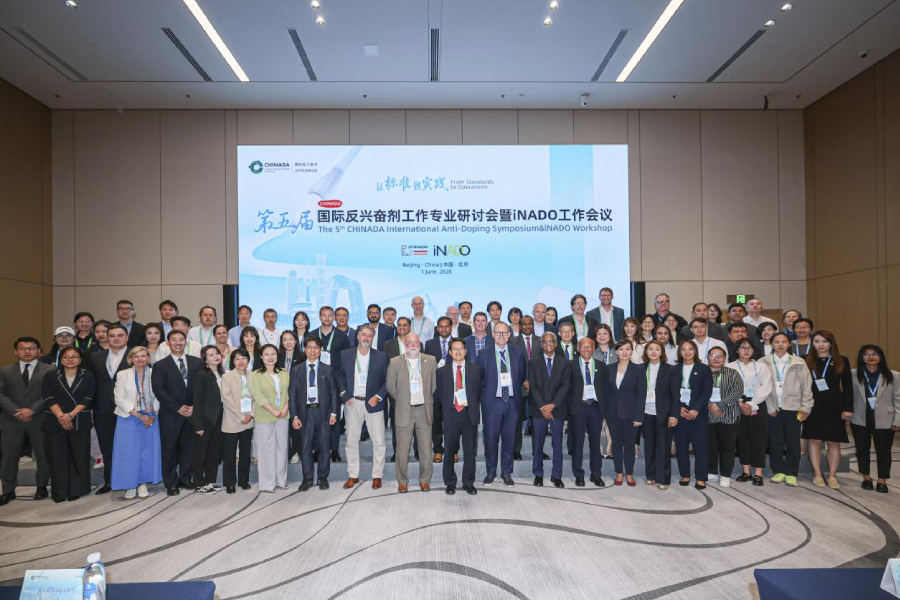
Participants pose for a group photo at the 5th CHINADA International Anti-Doping Symposium & iNADO Workshop in Beijing on June 1. (Photo provided to Guangming Online)
The symposium brought together nearly 150 participants, including representatives from NADOs, RADOs, anti-doping laboratories, academic institutions, and anti-doping experts from around the world.
点击右上角 微信好友
微信好友
 朋友圈
朋友圈

请使用浏览器分享功能进行分享