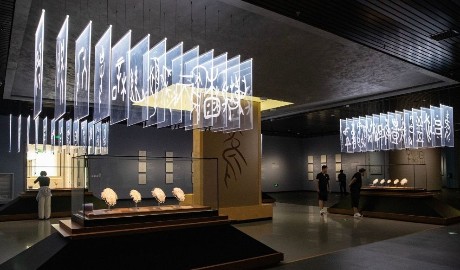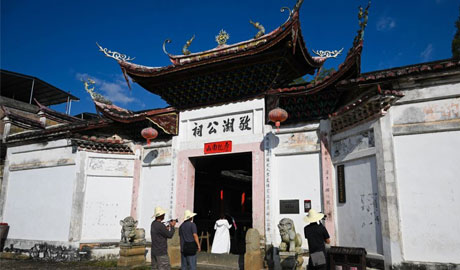


Foreign scholars, translators and publishing professionals attending a cultural exchange event at the China National Archives of Publications and Culture (CNAPC) on June 19, 2026, hailed the institution as an inspiring model for preserving civilization and promoting mutual understanding among different cultures in an interview with Guangming Online.
The visit formed part of the ninth Cultural Exchange Day, jointly organized by the China National Archives of Publications and Culture and China National Publications Import & Export (Group) Co., Ltd..
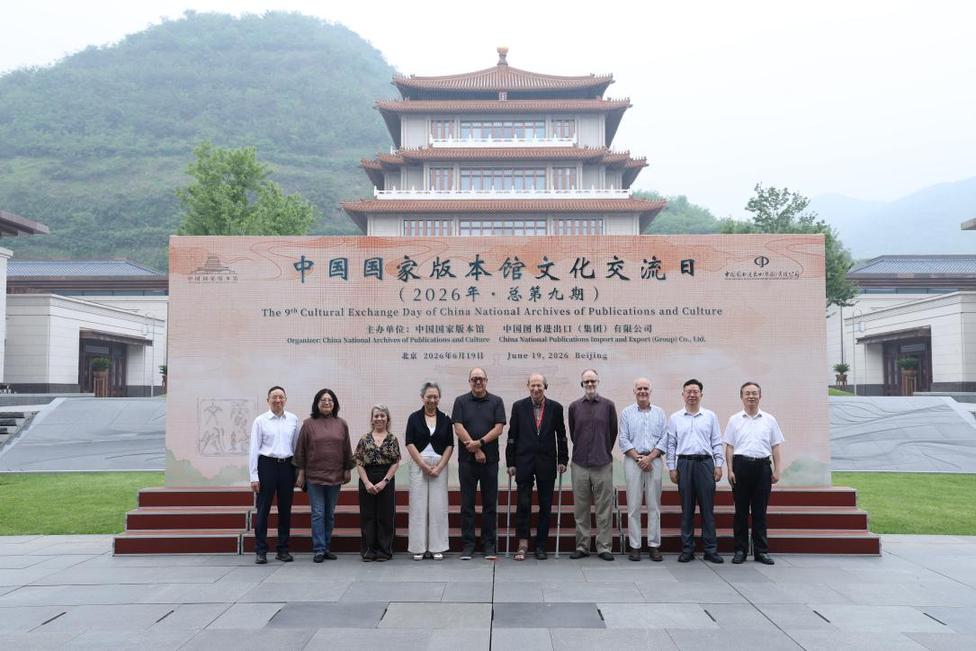
Guests pose for a group photo at the main exhibition venue of the China National Archives of Publications and Culture in Beijing, capital of China, June 19, 2026. (Photo provided to Guangming Online)
Liu Chengyong, Party Secretary and Director of China National Archives of Publications and Culture, and Cao Yongbin, Deputy Party Secretary of China National Publications Import & Export (Group) Co., Ltd. attended the event and delivered remarks. The Vice Director of the CNAPC, Xu Zhongyu, hosted the event.
Liu said the CNAPC is committed to promoting cultural exchange and mutual learning among civilizations, serving as a cultural bridge between China and the world through publications. As a “seed bank” of Chinese civilization and a national repository of publication resources, he said the institution not only preserves, displays, researches and exchanges cultural heritage, but also advances people-to-people exchanges to foster mutual understanding. He added that the CNAPC welcomes closer cooperation with global partners to jointly build bridges of friendship between civilizations.
Cao noted that China National Publications Import & Export (Group) Co., Ltd. is dedicated to using books as a medium to promote dialogue between China and the world. He expressed gratitude to the CNAPC for organizing the event and facilitating cultural exchange and shared outcomes, noting that continued cooperation would further advance mutual learning among civilizations.
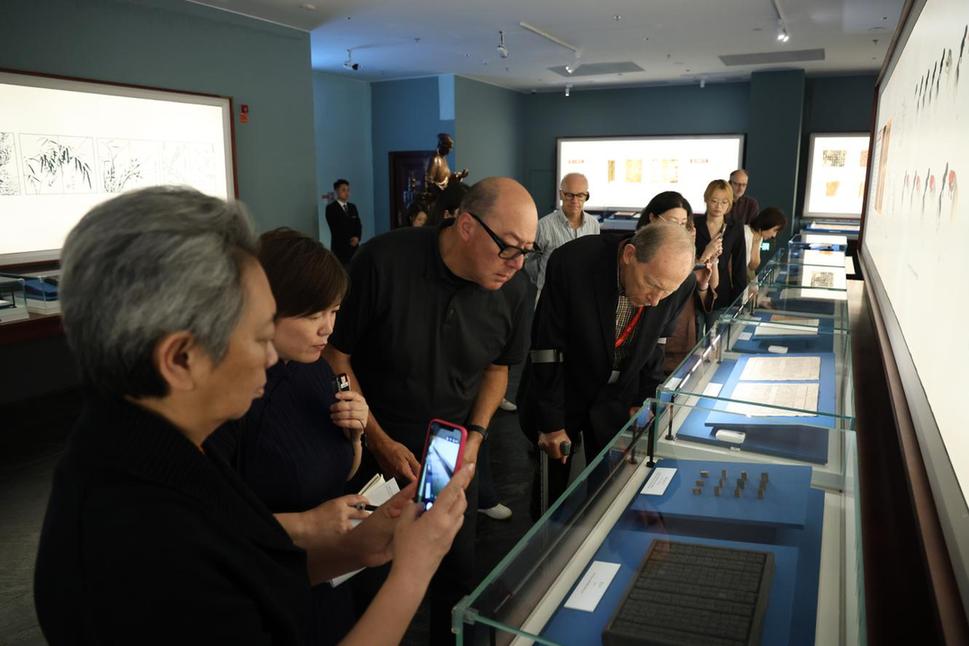
Foreign guests visit the main exhibition venue of the China National Archives of Publications and Culture in Beijing, capital of China, June 19, 2026. (Photo provided to Guangming Online)
Guests at the event included six winners of the 19th Special Book Award of China from Mongolia, the United Kingdom, the United States, Spain, the Netherlands and Argentina, which recognizes foreign contributors to the global dissemination of Chinese culture. They visited key exhibition areas showcasing ancient Chinese texts, rare editions, modern publishing works and traditional printing techniques, and experienced traditional cultural practices such as ancient book restoration and woodblock printing, gaining close insight into the vitality and craftsmanship of Chinese cultural heritage.
An on-site donation ceremony for China-themed English-translated publications was also held, during which a representative of British publisher ACA Publishing Ltd. donated English-language Chinese-themed books, including signed copies by well-known authors, to the CNAPC. The donation, received by Liu Chengyong on behalf of the institution, further enriches the CNAPC’s overseas publication holdings.
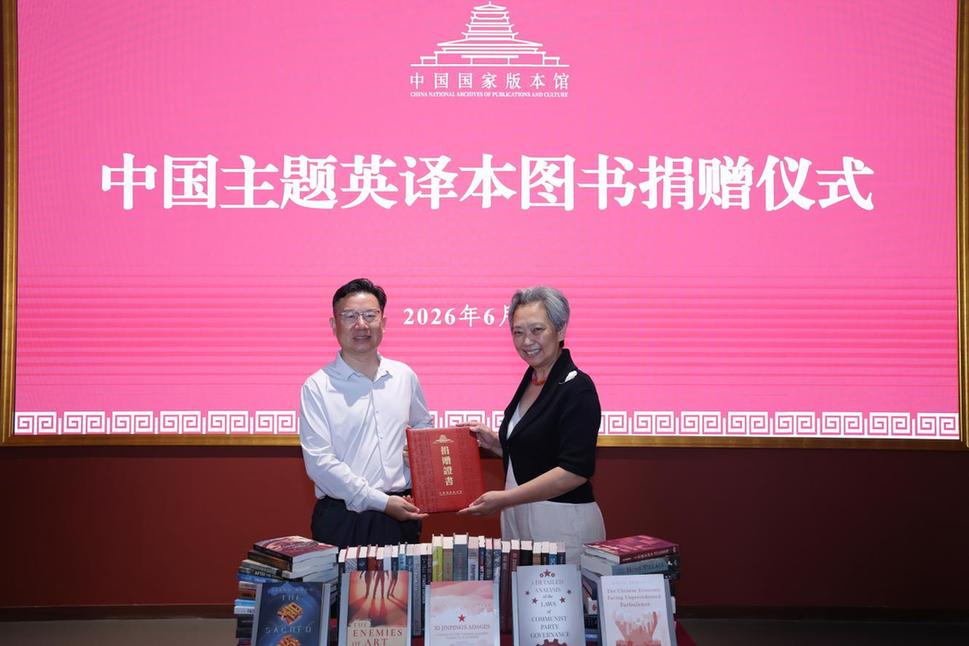
Photo taken on June 19, 2026 shows a donation ceremony for China-themed English-translated publications at the main exhibition venue of the China National Archives of Publications and Culture in Beijing, capital of China. (Photo provided to Guangming Online)
“A striking example of cultural preservation and presentation”
British publisher Martin Saville, Editor-in-Chief and Senior Editorial Consultant at ACA Publishing Ltd., said he was struck by the scale and setting of the Archive upon arrival.
“Since we got off the bus, the scale of the buildings and the landscape around them was impressive,” Saville said. “Inside, the way Chinese art and cultural heritage are preserved is very striking.”
Saville, who has worked on UK–China publishing exchanges for nearly 40 years, said publishing plays a critical role in reducing international misunderstanding.
“Without understanding, there is always suspicion between countries,” he said. “Publishing helps bridge that gap.”
He added that the Archive is not only a storage facility but also a curated cultural space. “It’s not just what is preserved, but how it is displayed. That presentation really amplifies its cultural value.”
Saville said similar institutions elsewhere would benefit global cultural exchange. “It would be good for human civilization if more countries had something like this.”
“Books remain while generations pass”
Spanish sinologist Gabriel Garcia-Noblejas, professor at the University of Granada, said the CNAPC represents both a conceptual vision and a concrete realization of cultural preservation on a civilizational scale.
“What impressed me most is the idea and its execution,” he said. “It is about preserving the past and transmitting it to future generations in a structured and lasting way.”
He said the project reflects a long-term approach to cultural continuity that goes beyond institutional archiving.
“It is not only about storing books,” he said. “It is about safeguarding the intellectual and spiritual foundations of a civilization. Books are what remain when generations disappear,” he said. “If you want to understand a culture, you must preserve its texts, study them, and share them.”
He also noted the broader international significance of such institutions.
“This model is not only important for China,” he said. “It can serve as an example for other countries seeking to protect and organize their cultural heritage.”
“Literature is a bridge across cultures”
Dutch translator Mark Leenhouts, who spent 13 years co-translating Dream of the Red Chamber into Dutch, said Chinese literary classics continue to resonate strongly with Western readers.
“Readers are often drawn either to its long narrative structure or to its deeper philosophical layers,” he said.
Leenhouts said his experience reflects the broader ability of literature to cross cultural boundaries and connect readers emotionally with distant societies.
“That is the power of great literature,” he said. “It can travel far beyond its original context.”
He also expressed appreciation for the Archives’ presentation of early Chinese writing systems, calling such preservation efforts essential for cultural continuity.
“Safeguarding written records is essential for civilizational continuity”
Mongolian scholar Egshig Egshigdashuren, associate professor at the National University of Mongolia, said the Archive demonstrates a systematic and comprehensive approach to preserving written heritage.
She described the institution as a significant safeguard for the written records of the Chinese nation and highlighted the close relationship between cultural preservation and civilizational continuity.
"A nation must preserve its written heritage," she said. "Protecting texts means protecting civilization itself."
Egshig also noted that China, as the only major ancient civilization that has continued uninterrupted into the present day, offers a unique example of cultural resilience. She said institutions such as the CNAPC play an essential role in ensuring that this legacy is passed on to future generations.
点击右上角 微信好友
微信好友
 朋友圈
朋友圈

请使用浏览器分享功能进行分享