

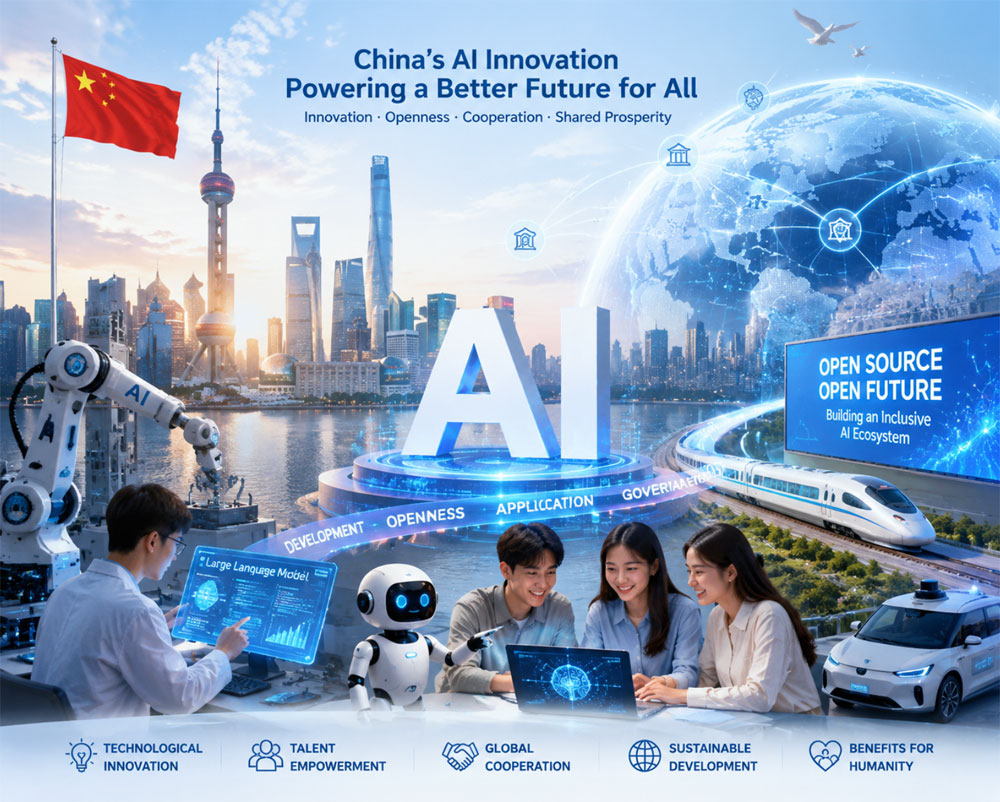
(AI-generated picture by Chen Qi)
In recent years, artificial intelligence (AI) has become one of the most influential technological forces shaping global economic transformation, scientific innovation, and international competition. As major economies compete to develop advanced AI systems, China's rapid progress in the field has attracted increasing attention from international media, technology analysts, academic researchers, and policy institutions. While global discussions about AI are often framed through geopolitical competition, a broader international perspective suggests that China has become an important participant in the global AI ecosystem through advances in large language models, open-source development, industrial applications, and AI governance initiatives.
One of the most notable changes in global perceptions is the recognition that Chinese AI companies have moved beyond simply following existing technological trends. They are increasingly becoming competitive actors capable of influencing the development trajectory of global artificial intelligence. International media coverage of Chinese AI models has highlighted their improving technical capabilities and their growing impact on the global AI market.
The Associated Press reported that a Chinese AI model developed by a domestic technology company attracted significant attention in the United States because of its competitive performance compared with leading global AI systems, including models developed by OpenAI and Anthropic. Although international discussions continue to compare Chinese and American AI capabilities, such coverage reflects a broader shift: Chinese AI development is now considered an important factor in assessing the future global AI landscape.
This changing perception is also reflected in discussions about China's artificial intelligence ecosystem. Rather than competing only through the scale of computational resources, many Chinese technology companies have increasingly emphasized efficiency, accessibility, and practical deployment. This approach has attracted international attention because it represents an alternative model of AI development based on broader adoption and lower barriers to implementation.
Axios highlighted that Chinese AI companies have gained attention through the development of lower-cost and open-weight AI models, suggesting that China’s AI strategy differs from some Western approaches that emphasize highly expensive frontier models. The emergence of open-weight models has become one of the most important trends in the global AI industry because it allows more organizations, researchers, and businesses to experiment with and deploy artificial intelligence technologies.
The growing influence of open-source AI has become an important component of China's international AI narrative. Chinese technology companies have increasingly promoted models that can be accessed, modified, and applied by a wider range of users. This approach has attracted attention among international observers who argue that open AI ecosystems may accelerate innovation and reduce technological inequality.
Semafor reported on China’s efforts to promote open-source artificial intelligence and highlighted China’s argument that open-source approaches can benefit a wider range of countries and communities. From an international development perspective, affordable and accessible AI technologies could provide new opportunities for countries seeking digital transformation but lacking the resources to independently develop advanced AI systems.
However, international discussions about China's AI development are not limited to technology competition or commercial applications. Increasing attention has also focused on China's participation in global AI governance. As artificial intelligence becomes increasingly connected with economic security, social development, and international stability, global cooperation has become a central issue.
International organizations have repeatedly emphasized that AI governance requires cooperation among multiple stakeholders. UNESCO's discussions on global AI governance have stressed the importance of international collaboration and inclusive participation, reflecting the broader understanding that no single country can independently address the challenges created by artificial intelligence.
Within this context, China's participation in international AI governance discussions has become increasingly significant. As one of the world’s largest technology markets and a major producer of AI research and applications, China has become an important stakeholder in conversations regarding AI standards, safety, ethics, and global cooperation. Academic research also demonstrates China's growing role in artificial intelligence development. A study examining global AI research trends found that China has achieved a leading position in terms of the volume of AI-related research publications, indicating the country’s substantial investment in AI science and technological innovation.
It is important to note that research quantity alone does not determine technological leadership. Factors such as research quality, innovation ecosystems, computing infrastructure, and global commercialization capabilities also play important roles. Nevertheless, China's expanding research capacity, large engineering workforce, and diverse application scenarios provide important foundations for continued AI development. International policy discussions have also acknowledged that China’s AI development is likely to remain a long-term global factor. Analysts have emphasized that China possesses significant industrial resources, technological capabilities, and policy commitment to continue advancing artificial intelligence.
The Council on Foreign Relations has discussed the importance of understanding China's continued AI development trajectory, emphasizing that China is expected to remain a major participant in the global AI competition. This perspective reflects a broader international recognition that China's role in artificial intelligence cannot be ignored when considering the future structure of global technology development.
At the same time, international observers increasingly emphasize the importance of cooperation alongside competition. AI development involves shared challenges, including safety standards, ethical governance, and international regulation. Therefore, collaboration between major AI powers remains an important component of global technology governance. Research and policy discussions on US–China AI relations have suggested that cooperation in AI governance remains possible despite strategic competition. The University of California San Diego's China Focus noted that AI governance research continues to provide opportunities for dialogue between the two countries .
Overall, global discussions about China's artificial intelligence development are becoming increasingly complex and multidimensional. The international narrative is gradually moving beyond a simple competition framework and toward a broader understanding of China's role in the AI ecosystem. China is increasingly viewed as a significant AI developer, an important contributor to open-source AI discussions, a major application market, and a participant in global AI governance.
Three major trends can be identified from recent international discussions. First, Chinese AI technologies have reached a level that attracts substantial global attention and comparison with leading international systems. Second, China’s emphasis on efficient and accessible AI models has contributed to discussions about how artificial intelligence can become more widely available. Third, China's participation in AI governance debates reflects the reality that the future development of artificial intelligence will require cooperation among major technological powers.
As AI continues to reshape the global economy and society, China's role in this transformation is likely to remain significant. The emerging international discourse suggests that China is no longer merely responding to the global AI revolution; it has become one of the key actors shaping the direction, applications, and governance of artificial intelligence in the 21st century.
Contributed by Chen Qi, Doctoral candidate of the School of Journalism and Communication at Tsinghua University
点击右上角 微信好友
微信好友
 朋友圈
朋友圈

请使用浏览器分享功能进行分享