


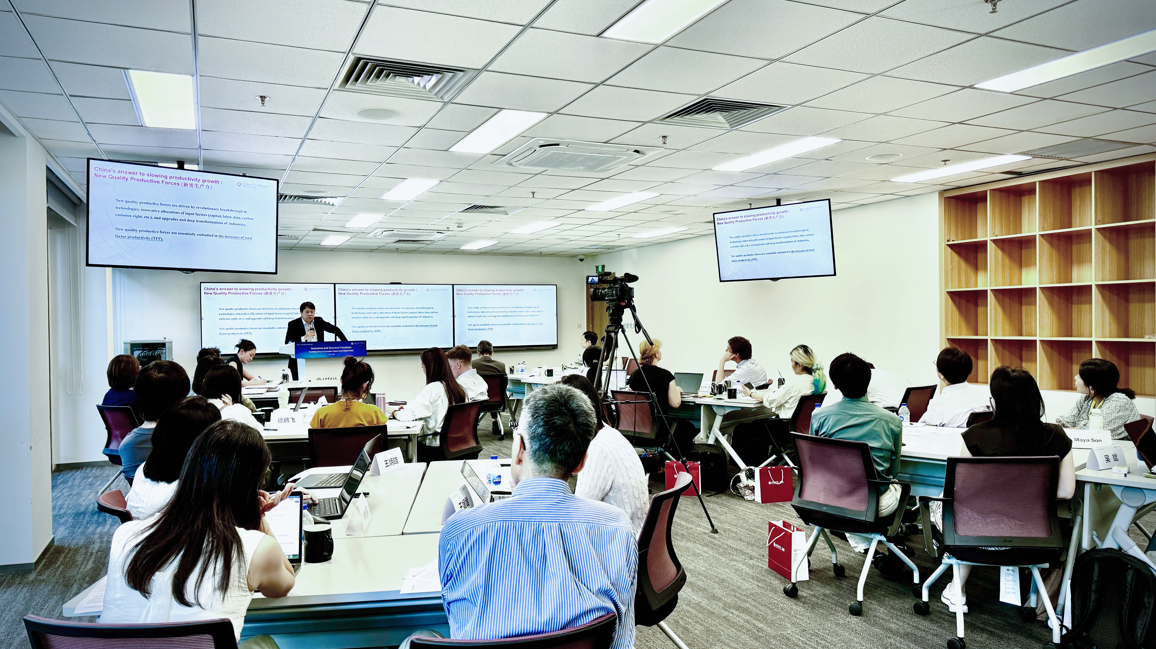
Peking University Guanghua School of Management (PKU Guanghua) hosted the 11th International Media Salon in Beijing, July 17, 2026. (Photo provided to Guangming Online)
BEIJING - Peking University Guanghua School of Management hosted its 11th International Media Salon on July 17, 2026, bringing together three faculty members to discuss China's research and development landscape, artificial intelligence and economic policy, and shifts in services and manufacturing.
Nearly 30 journalists and representatives from over a dozen international media outlets and institutions participated in the event and engaged in in-depth discussions.
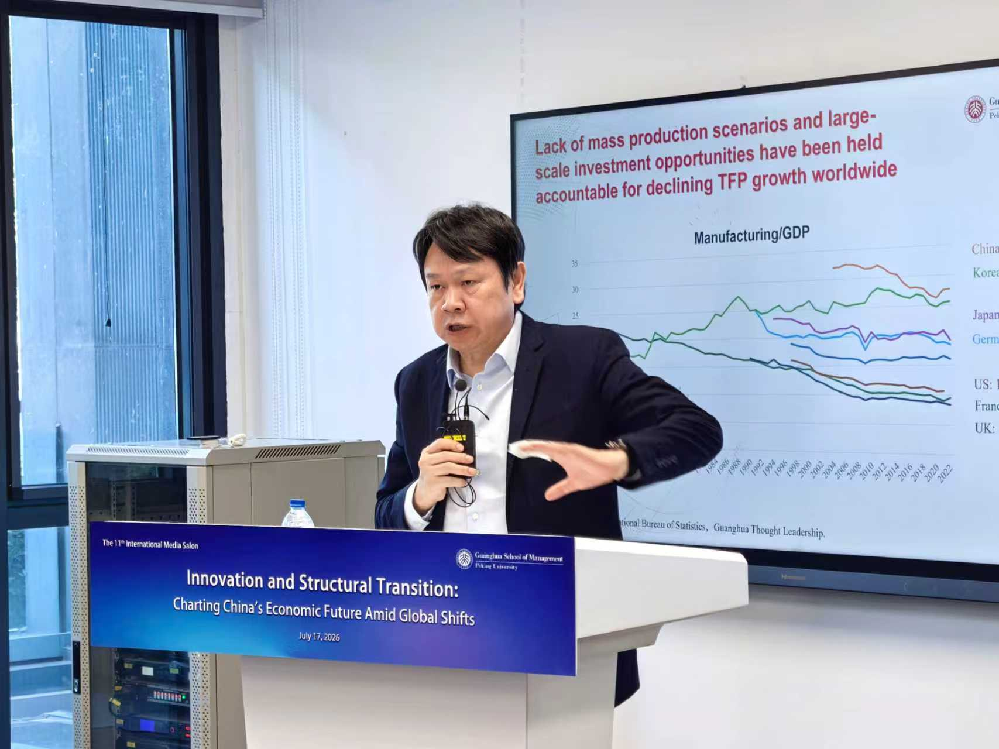
Professor Liu Qiao speaks at the 11th International Media Salon in Beijing, July 17, 2026. (Photo provided to Guangming Online)
Liu Qiao, Boya Distinguished Professor of Peking University and the Former Dean of Guanghua School of Management, said the focus of investment is expected to gradually shift from traditional areas such as infrastructure and fixed assets toward human capital, healthcare, education and other service sectors. Liu pointed out that China’s next phase of growth will hinge on both the development of AI-driven future industries and productivity gains in traditional sectors such as services, healthcare, education and finance.
How should the success of the government's "Investing in People" strategy be measured? Liu noted that policymakers should look beyond GDP growth as the primary performance indicator for local governments and place greater emphasis on household income and consumption. He also called for a reorientation of macroeconomic policy, suggesting that fiscal and monetary measures should gradually shift their focus from boosting production and manufacturing to strengthening consumption and domestic demand.
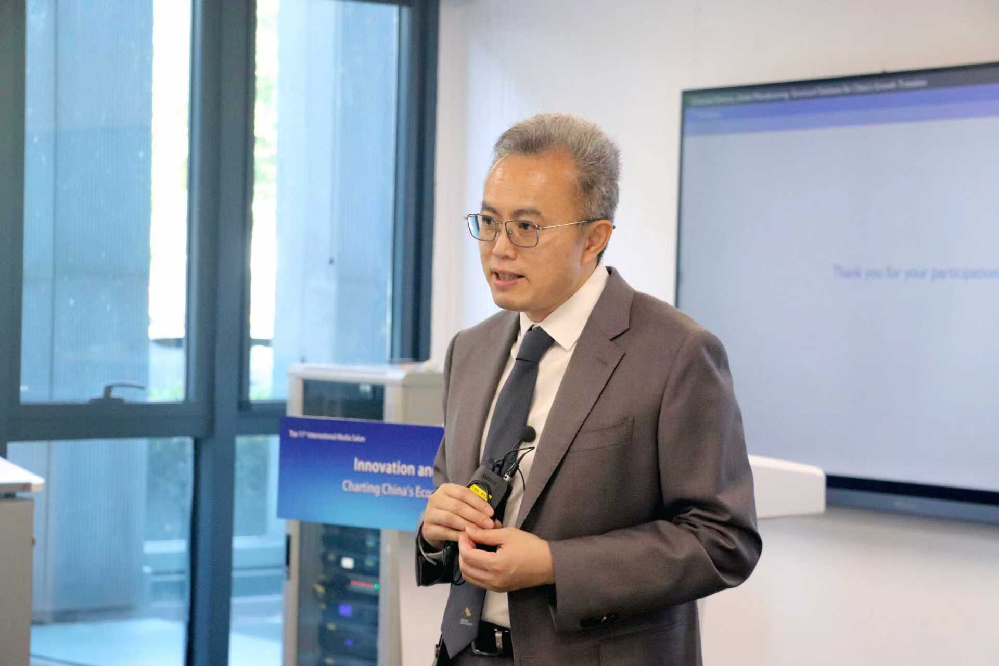
Professor Tang Yao speaks at the 11th International Media Salon in Beijing, July 17, 2026. (Photo provided to Guangming Online)
Tang Yao, Associate Professor of Applied Economics at Guanghua School of Management and Vice Director of the Center for Management Science at Peking University, examined the structural challenges facing China’s economy and explored pathways toward more sustainable growth.
Tang pointed out that China’s future consumption growth is likely to come primarily from the service sector. In addition to leveraging major events such as concerts and sporting events to boost service consumption, he said it is equally important to encourage the entry of small businesses to foster a more diverse range of services.
Despite growing global uncertainty, Tang noted that China’s manufacturing sector is becoming more deeply integrated into the global economy rather than decoupling from it. Looking ahead, Tang said China could also provide integrated solutions for countries seeking to build more diversified and resilient supply chains. For example, in pursuing the energy transition, China can offer integrated packages of renewable energy infrastructure, power grid technologies and new energy vehicles.
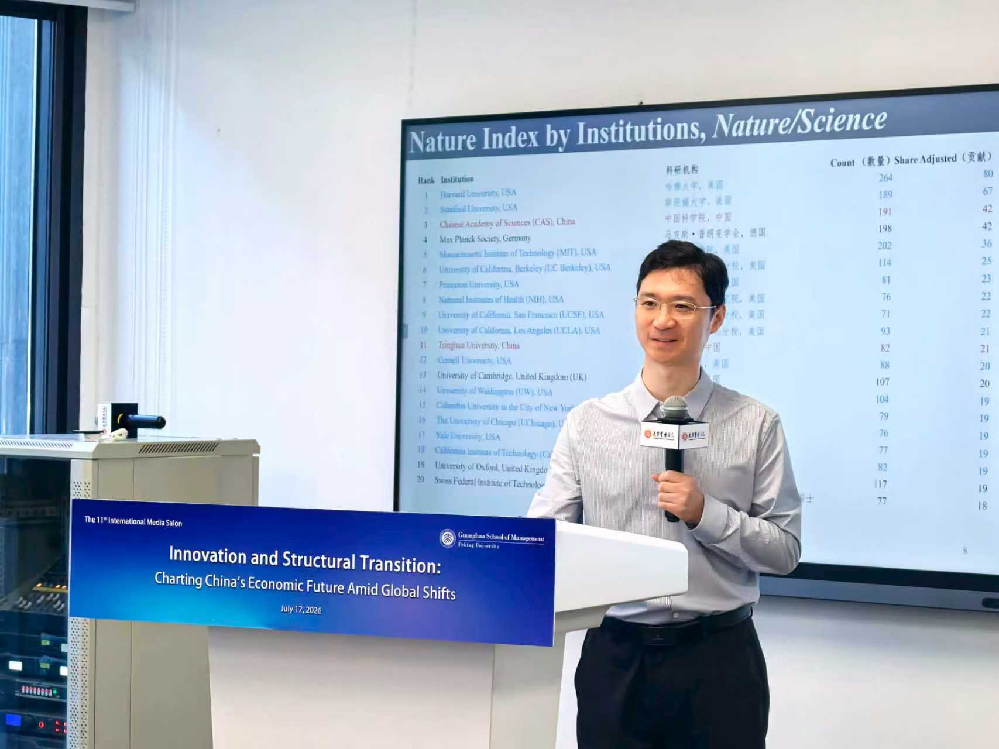
Professor Han Pengfei speaks at the 11th International Media Salon in Beijing, July 17, 2026. (Photo provided to Guangming Online)
Han Pengfei, Associate Professor of Finance at Guanghua School of Management, noted that China has demonstrated remarkable resilience amid global geopolitical tensions, leveraging a renewable energy transition that fuels both domestic growth and the global green shift. He highlighted China’s expanding role as a global investor, pointing out that the country surpassed Japan in 2025 to become the world’s second-largest capital exporter.
The event concluded with discussions on global industrial restructuring, AI-driven productivity and China's economic transition.
点击右上角 微信好友
微信好友
 朋友圈
朋友圈

请使用浏览器分享功能进行分享