

China has secured continued improvement in eco-environmental quality and effectively safeguarded people’s environmental rights, according to the Assessment Report on the Implementation of the National Human Rights Action Plan of China (2021-2025) jointly released on June 5, 2026, by the China Society for Human Rights Studies and 20 national human rights education and training bases in the country.
The report assesses the implementation of the National Human Rights Action Plan of China (2021-2025), which was issued in September 2021.
The third chapter assesses the progress made in meeting the targets related to strengthening the protection of environmental rights. Below are some highlights from the report:
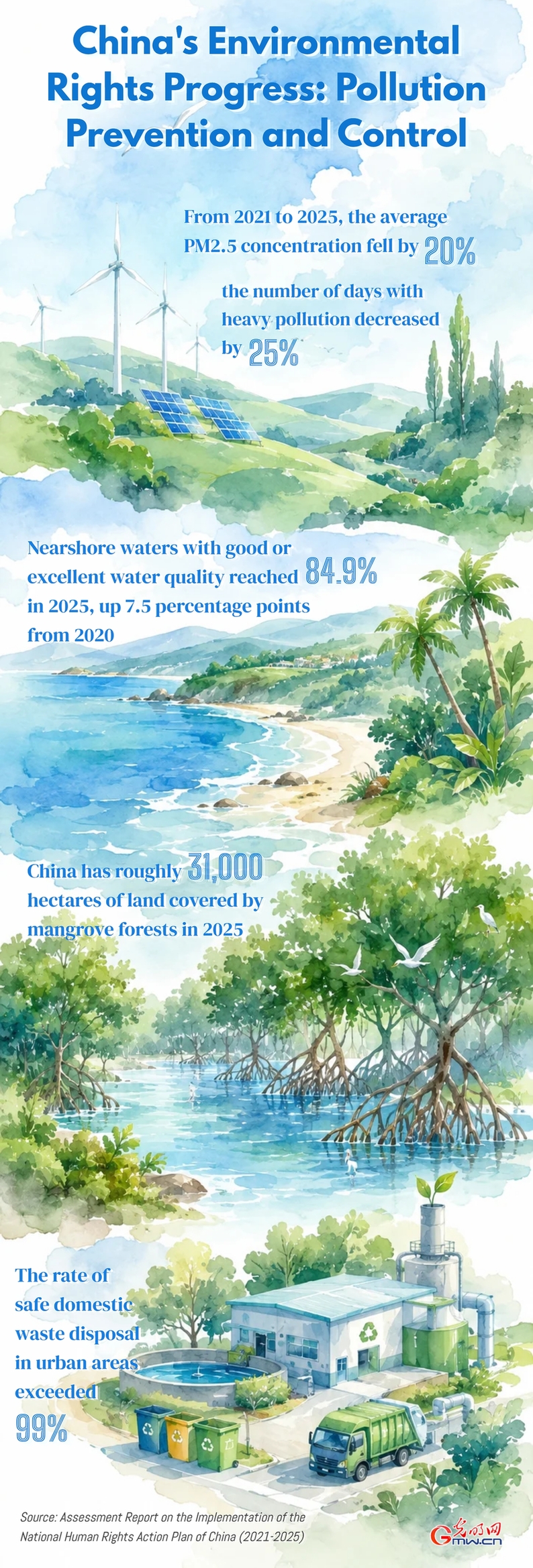
From 2021 to 2025, the average concentration of PM2.5 in China has fallen by 20%, and the number of days with heavy pollution has decreased by 25% from 2021 to 2025.
In 2025, China's nearshore sea areas with good to excellent water quality were 84.9%, up by 7.5% compared with 2020. China has become one of the few countries in the world where mangrove coverage has increased, with roughly 31,000 hectares of land now covered by mangrove forests.
China's domestic waste incineration capacity has increased by 62.2% compared with 2020, and the rate of safe domestic waste disposal in urban areas has exceeded 99%.
In 2025, the national capacity for centralized hazardous waste reuse and disposal stood at nearly 250 million tonnes, and that for centralized medical waste disposal stood at around 3.2 million tonnes per year, up by approximately 76% and 71%, respectively, compared with 2020.
Eco-environmental authorities at all levels have handled 402,400 administrative penalty cases, and public security agencies have filed and investigated 13,000 criminal cases involving environmental pollution.
点击右上角 微信好友
微信好友
 朋友圈
朋友圈

请使用浏览器分享功能进行分享