


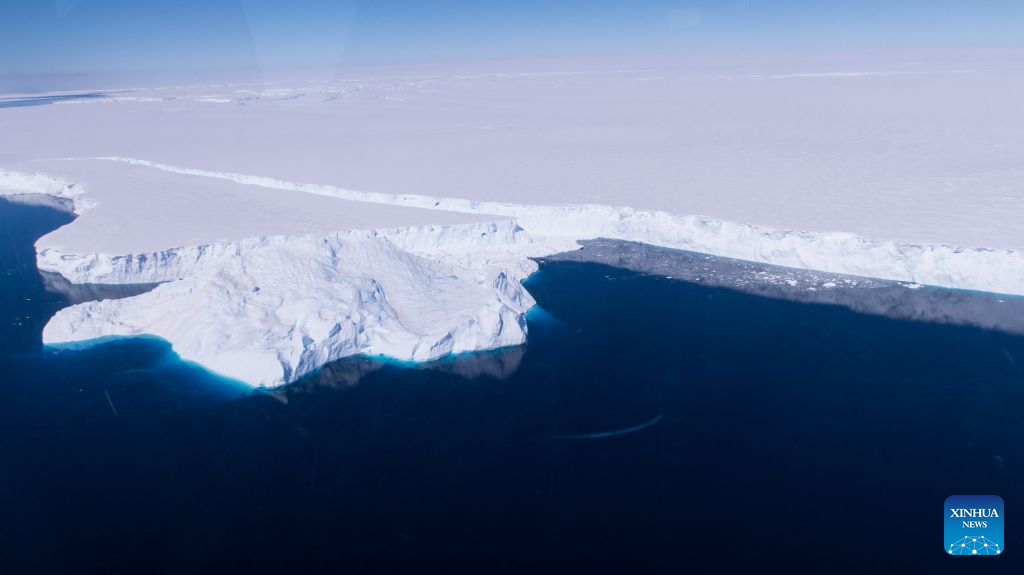
An aerial drone photo taken on Dec. 17, 2019 by Yoshihiro Nakayama, one of the researchers of the study, shows a view of the Totten Ice Shelf in East Antarctica. (Photo by Yoshihiro Nakayama/Xinhua)
QINGDAO, Aug. 20 (Xinhua) -- A temporary reversal in Antarctic ice-sheet mass loss from July 2021 to April 2023 has been traced to multiyear warming in the tropical warm pool spanning the western Pacific and eastern Indian oceans, according to a study by researchers from China, the United States, Japan, Belgium and Hungary.
Data from satellites that track changes in Earth's gravity showed that the Antarctic Ice Sheet gained about 695 billion tonnes of mass during the period. It was the largest mass-gain event since the satellite record began in 2003. The episode temporarily interrupted a long-term loss trend that averaged about 140.5 billion tonnes per year from 2003 to 2024, according to the study.
"Antarctic ice-sheet mass loss has been a major contributor to global sea-level rise in recent decades, increasing the risk of coastal flooding and worsening storm-surge damage for coastal communities worldwide. But scientists didn't know why the ice sheet had gained so much mass over those two to three years," said Wang Yunhe, lead author of the study and a researcher at the Institute of Oceanology, Chinese Academy of Sciences.
The study found that about 68 percent of the mass increase was concentrated in East Antarctica's Queen Mary Land-Wilkes Land region. The immediate cause was heavy and persistent snowfall there. But the underlying climate trigger originated thousands of kilometers away.
The researchers traced the unusual snowfall back to persistent warming in the tropical warm pool, a vast warm region spanning the western Pacific and eastern Indian oceans that contains some of the warmest seawater on Earth.
From 2021 to 2023, the warming set off large-scale waves in the atmosphere that traveled thousands of kilometers toward Antarctica. There, the waves changed wind patterns and steered moist air from the mid-latitude Indian Ocean toward Queen Mary Land-Wilkes Land. The result was sustained heavy snowfall that added substantial mass to the ice sheet.
"However, this temporary slowdown has not reversed the long-term trend of Antarctic ice-sheet mass loss, and West Antarctica remains the main region of sustained mass loss," Wang said.
"Understanding how Antarctic ice mass changes helps scientists better project sea-level rise. More reliable projections can help coastal communities prepare for more frequent flooding and greater storm-surge damage to homes, roads and other infrastructure," he said.
"That planning needs to account for both the long-term rise in sea level and shorter-term natural climate swings," he added.
The study was published online in Nature on Wednesday.

Tourists enjoy autumn scenery at Temple of Heaven Park in Beijing

Chinese cultural night in Kuwait highlights Hebei's traditional arts
Autumn scenery in Guangwu Mountain scenic area in Bazhong, SW China's Sichuan

Chinese cultural night in Kuwait highlights Hebei's traditional arts

Across China: Roses honoring two late women who served rural China go on sale
点击右上角 微信好友
 朋友圈

请使用浏览器分享功能进行分享