

(AI-assisted creation provided to Guangming Online, by Chen Qi)
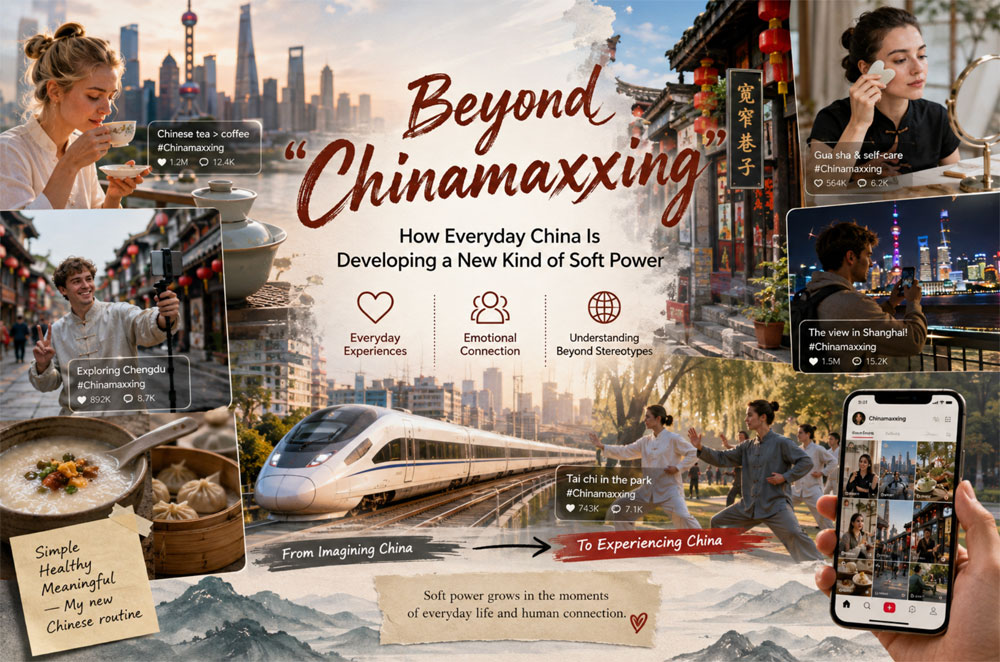
The rise of "Chinamaxxing" across Western social media may look, at first glance, like just another internet meme. Young Americans and Europeans post videos of themselves drinking hot water, eating congee, wearing Chinese-inspired fashion, using gua sha, or embracing slower daily routines. Yet the phenomenon deserves more serious attention. As several international media outlets have observed, "Chinamaxxing" is not simply a passing fascination with Chinese cultural symbols. More importantly, it may reflect a subtle but significant change in the way China is being encountered, discussed and imagined by international audiences.
For decades, the international narrative on China has been tainted by geopolitical and strategic frameworks. Terms such as "China threat" and "strategic challenge" have to a great extent dominated the global public opinion space, overshadowing the everyday experiences of the ordinary Chinese. The recent "Chinamaxxing," however, suggests that another dimension of China is becoming increasingly visible: China as an everyday place, a lived culture and another source of lifestyle experiences.
This shift matters because national images are not constructed only through diplomacy, political discourse or traditional cultural exports. They are also formed through ordinary encounters: food, fashion, street scenes, technology, leisure, family routines, wellness practices and interpersonal relationships. In this sense, "Chinamaxxing" offers an interesting window into an authentic China that may deviate considerably from previous stereotypes.
International media coverage has repeatedly highlighted this movement from an abstract China toward an experiential China. CNN, for example, described "Chinamaxxing" as a growing fascination among young Americans with Chinese culture and aesthetics, comparing the phenomenon with the earlier global popularity of Korean dramas, K-pop and Japanese popular culture. Business Insider similarly noted that young Americans are increasingly encountering China not as a "static or traditional image," but as a "modern, aesthetic, and confident" society through influencers and social media.
What is particularly significant is what international audiences are choosing to notice. The China they encounter online is not necessarily the China in diplomatic statements or political debates. It is the China of a warm breakfast, a cup of tea, a neighborhood lane, a high-speed train, a modern city skyline, a traditional exercise routine or a visit to a local market. These seemingly mundane experiences may appear insignificant when compared with grand narratives of national development. Yet they are precisely the kinds of experiences through which people establish emotional connections with a foreign country.
This is where the concept of soft power becomes especially relevant. Traditionally, soft power has been understood largely in terms of a country's ability to attract others through culture, values and policies. But the "Chinamaxxing" phenomenon suggests a more experiential and affective dimension of attraction. Pan Wang of the University of New South Wales describes this emerging dynamic as China's "affective soft power," in which social media influencers and everyday digital practices reshape international perceptions beyond formal state messaging. China becomes attractive through the familiarity, usefulness and emotional resonance of ordinary cultural practices.
This is an important development in China's international communication. Soft power does not necessarily begin with people agreeing with a country's political system or foreign policy. It may begin with curiosity. A person tries Chinese tea, watches a Chinese drama, becomes interested in Chinese fashion, follows a Chinese creator, visits Shanghai or Chengdu, and gradually develops a more complex understanding of Chinese society. Attraction can therefore emerge through small experiences accumulated over time.
The role of digital platforms is crucial in this process. Social media has fundamentally changed who can participate in the construction of a country's international image. In the past, international audiences largely encountered China through professional journalists, governments, diplomatic institutions and major media organizations. Today, an individual traveler holding a smartphone can become a storyteller about China. A short video filmed in Chongqing, Shanghai, Chengdu or Shenzhen can reach millions of viewers without passing through traditional media gatekeepers.
The international media repeatedly points to this transformation. The East Asia Forum argues that "becoming Chinese" decouples "Chineseness" from citizenship and ethnicity, turning it into something that can be learned and experienced through everyday practices. This is perhaps one of the most interesting aspects of the phenomenon. China is no longer represented only as a nation-state "out there"; elements of Chinese culture are becoming resources that foreign individuals can incorporate into their own everyday lives.
The same process can be seen in the growing popularity of China-related travel contents. Young foreign visitors are increasingly documenting their experiences in China, from modern infrastructure and urban transportation to local food and neighborhood life. Some international media reports suggest that these firsthand encounters can challenge expectations formed before visiting China. The result is not necessarily unconditional admiration, but often a more concrete and nuanced understanding of Chinese society.
This points to a broader transformation in international image construction: the world is increasingly moving from imagining China to experiencing China.
That distinction is important. An imagined China can easily become an abstract projection shaped by political narratives, ideological assumptions or stereotypes. An experienced China is more complicated. It contains both impressive and ordinary aspects. But precisely because it is grounded in personal experience, it has the potential to produce a more multidimensional national image.
"Chinamaxxing" should therefore not be interpreted simply as evidence that young Westerners have suddenly "fallen in love with China." International media themselves have pointed out that the trend is partly connected to dissatisfaction with Western lifestyles and politics. Some participants are responding to burnout, searching for slower routines or expressing frustration with their own societies. This does not diminish the significance of the phenomenon. On the contrary, it reveals that Chinese culture is becoming part of a global conversation about how people want to live.
There are also legitimate limitations. Some aspects of "Chinamaxxing" risk reducing a complex civilization to a collection of easily consumable lifestyle symbols. Concerns about cultural appropriation and superficial understandings of traditional practices should not be ignored. International fascination with China should ultimately move beyond hot water, slippers or wellness routines toward deeper engagement with Chinese history, society and contemporary life.
Yet even with these limitations, the trend represents a meaningful opportunity. The Guardian's coverage notes that some observers see "Chinamaxxing" as a more humanizing representation of Chinese culture. This observation points toward an important lesson: international communication may become more effective when it allows China to be encountered through ordinary people and ordinary life.
The future of China's soft power may therefore depend not only on producing more cultural products or increasing official communication, but also on making space for people around the world to encounter China directly. Cities, neighborhoods, food, transportation, public spaces, festivals, workplaces and everyday interactions can all become points of connection.
Ultimately, "Chinamaxxing" is less important as a label than as a signal of a deeper change. International perceptions of China are increasingly being constructed through everyday experience. The China that appears on global social media is not simply the China presented by institutions; it is also the China experienced by travelers, residents, creators and ordinary users.
For China, this may be one of the most promising dimensions of contemporary international communication. A country's global image is strengthened when people around the world can see, experience and share the ordinary realities of its society. In that sense, the most powerful story about China may not always be a grand one. Sometimes, it may begin with something as simple as a cup of hot water.
Contributed by Chen Qi, Doctoral candidate of the School of Journalism and Communication at Tsinghua University
点击右上角 微信好友
微信好友
 朋友圈
朋友圈

请使用浏览器分享功能进行分享