

Tongguan kilns give ancient art form its modern shape with perfect geography and precise techniques, report Yang Feiyue and He Chun in Changsha.
By Yang Feiyue and He Chun
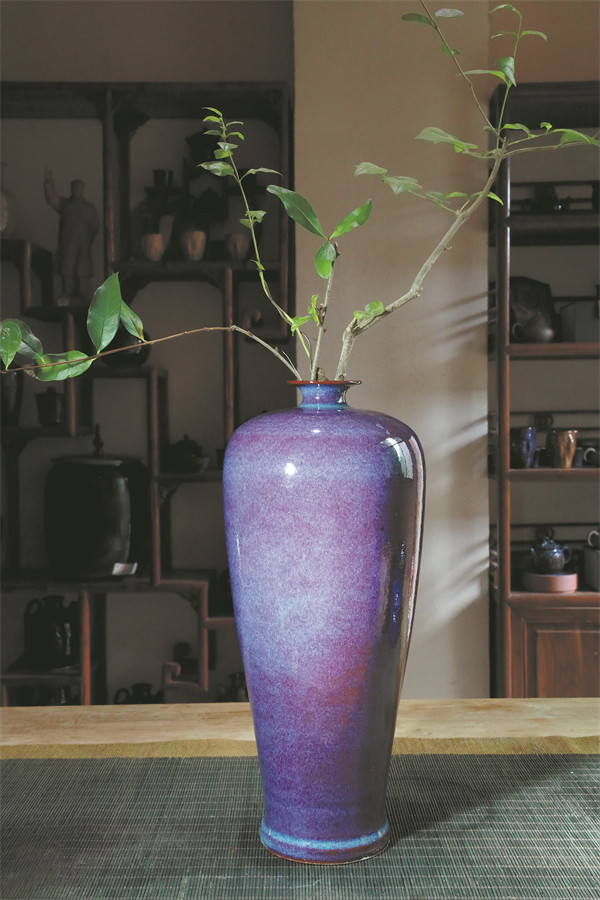
In the Tongguan Old Street, Changsha kiln ware ranges from vases, teapots to a variety of cups and ornaments in various shapes and sizes. [Photo provided to China Daily]
Tongguan's traditional dragon kilns, built into hillsides, are a sight to see, using the natural slope for draft, saving fuel, and ensuring even temperatures.
"Firing is the ultimate test of skill," Liu says. "The temperature is gradually increased to over 1,000 degrees."
Additionally, the flame needs constant observation through peepholes, timing the wood just right. The true magic happens during the yaobian, or kiln transformation. At a critical temperature, complex chemical changes in the glaze's metallic oxides create unexpected colors and textures.
"Yaobian is the art between control and chance," says Huang Haofu, a young artisan who also set up shop a few steps away from Liu's.
Many of his works, including lidded bowls, appear blue-black in the dark, but when natural or electric light hits them, specks of blue crystal seem to float within the glaze like a starry sky.
"These blue spots are iron crystals that precipitate at specific temperatures. Each piece is unique, and you can never predict what will emerge when the kiln is opened."
He admits that the success rate in his studio is only around 30 percent:"A good yaobian has layers, a sense of movement, something that sparks the image of landscapes or clouds."
Perhaps the Changsha kiln's unique cultural contribution was firing poetry onto ceramics.
点击右上角 微信好友
微信好友
 朋友圈
朋友圈

请使用浏览器分享功能进行分享