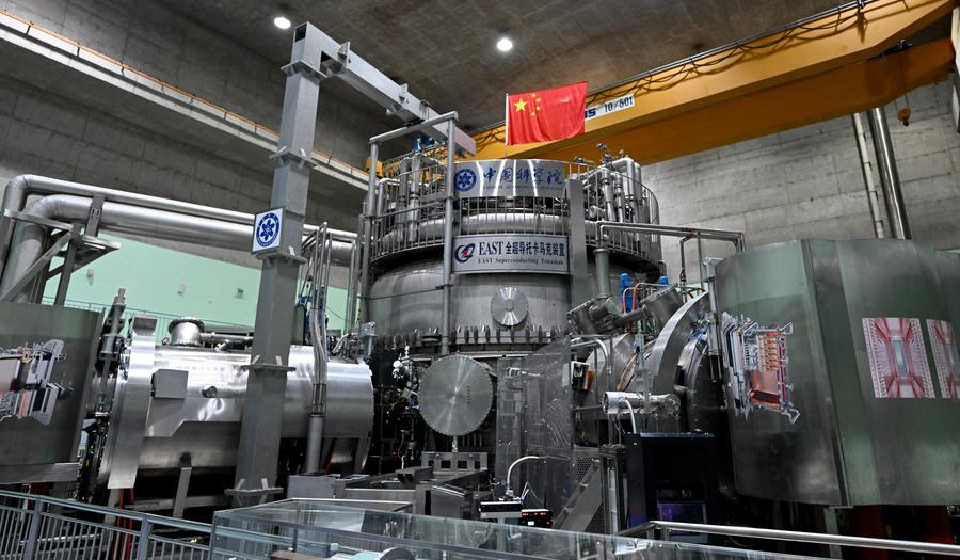


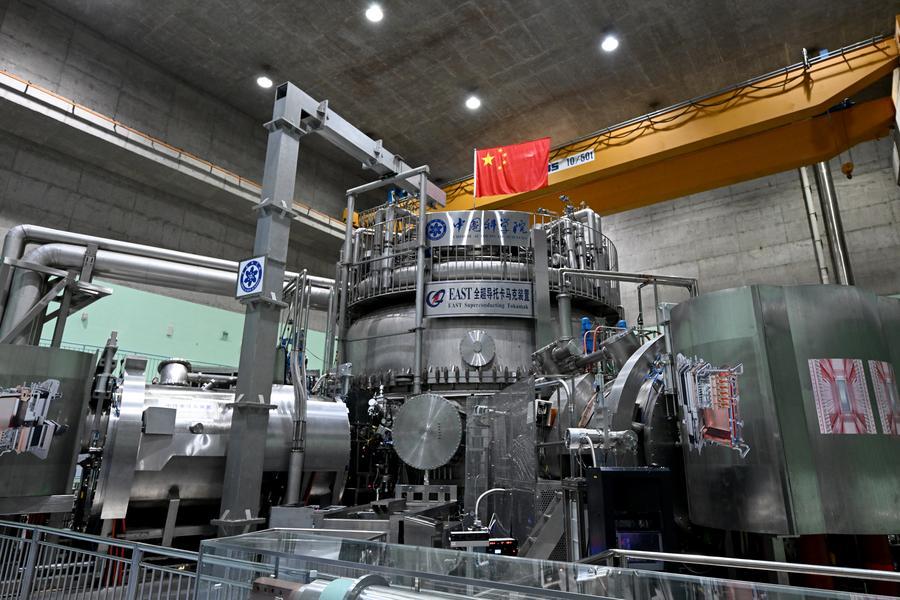
This photo taken on Jan. 15, 2025 shows the nuclear fusion research facility Experimental Advanced Superconducting Tokamak (EAST) in Hefei, east China's Anhui Province. (Xinhua/Huang Bohan)
BEIJING, March 25 (Xinhua) -- China will provide global researchers with access to ten of its major scientific research facilities this year, as announced during the opening ceremony of the 2026 Zhongguancun Forum (ZGC Forum) Annual Conference held in Beijing on Wednesday.
These installations will include some of China's most advanced scientific research platforms, including the Five-hundred-meter Aperture Spherical Radio Telescope (FAST) located in southwest China's Guizhou Province, the Space Environment Simulation and Research Infrastructure in northeast China's Heilongjiang Province, and the Experimental Advanced Superconducting Tokamak in Anhui Province in east China.
According to the announcement, this move aims to further advance the Action Plan for International Cooperation in Open Science, a project initiated by China and global partners in 2025 to foster an open, fair, equitable and non-discriminatory global environment for scientific and technological development.
China is driving its technological innovations through high-level international cooperation. The outline of its 15th Five-Year Plan (2026-2030) for national economic and social development, released earlier this month, proposes fostering an open and innovative ecosystem with global competitiveness, and supporting joint efforts by scientists from around the world to tackle fundamental and frontier scientific challenges.
Across China: Hungarian cultural delegation explores ancient architecture in China's Shanxi
Hungarian cultural delegation explores ancient architecture in China's Shanxi

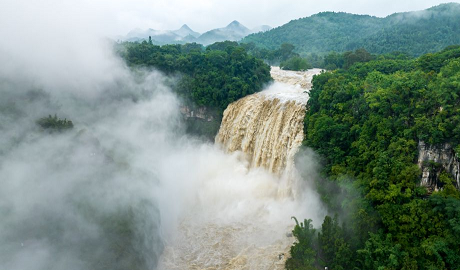
Huangguoshu Waterfall in SW China witnesses flow surge due to continuous rainfall
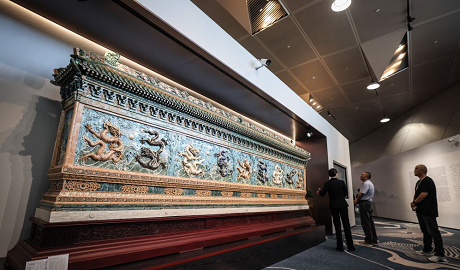
Exhibition of intangible cultural heritage opens to visitors during Summer Davos in China's Dalian
点击右上角 微信好友
微信好友
 朋友圈
朋友圈

请使用浏览器分享功能进行分享