



China develops transportation infrastructure to alleviate poverty in rural areas
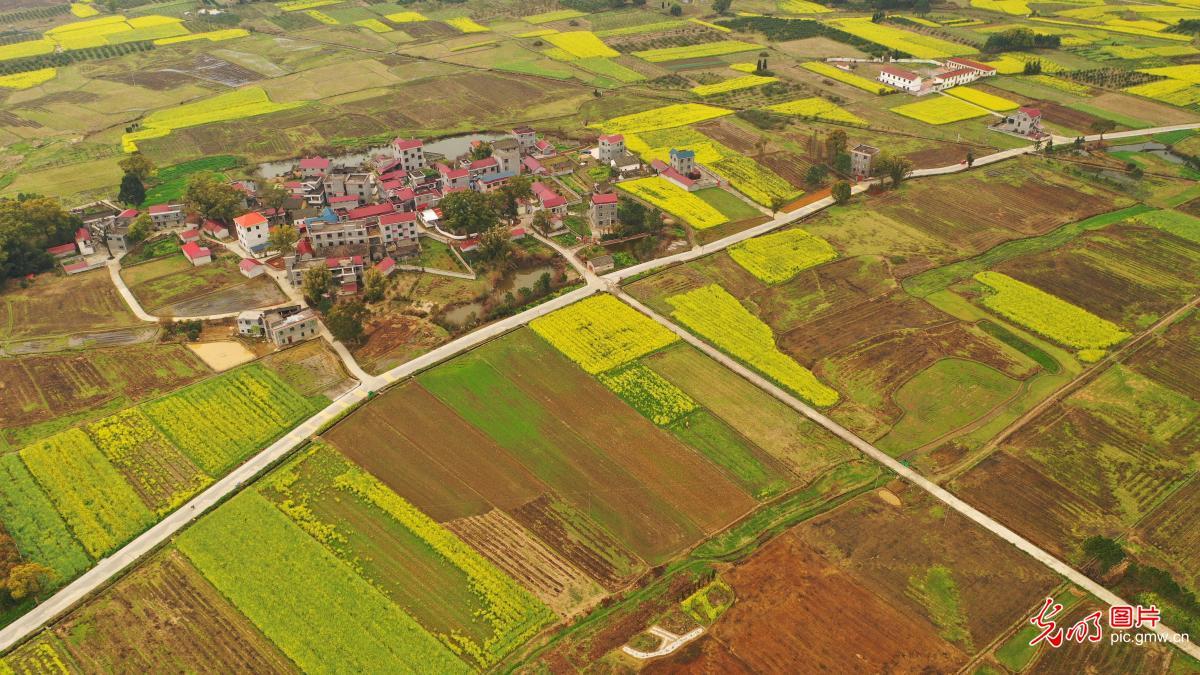
Aerial photo taken on March 7, 2021 shows a highway passing through Gaoxi Village, Suxi Toanwhip, Taihe County, Ji'an City, east China's Jiangxi Province. (Photo by Deng Heping/Guangming Picture)
How can transportation affect poor people?
In China, there's a saying that goes, "if you want to get rich, build roads first." The proverb indicates the significant influence of transportation infrastructure on poverty alleviation.
For people living in rural areas or remote areas, lack of such basic infrastructure as roads and bridges prevents them from, firstly, communication with other rural communities. People are not only isolated, but also denied access to markets, in which they can exchange goods and receive income, as well as to healthcare, education, and other social services.
It is fair to say that poverty alleviation hinges greatly on the improvement and development of transportation infrastructure. Building roads and bridges can connect rural communities, provide them with safer and faster access to markets and social services, help introducing such technologies as modern farming methods. All these will help increase people's income and alleviate extreme poverty, and further improve people’s livelihoods.
What has China done to improve its transportation infrastructure in poor areas?
China is keenly aware of the role of transportation in poverty alleviation. It has made great effort to pave roads, build bridges, upgrade transportation network, and clear the bottlenecks that hinder the development of rural areas.
From 2012 to 2019, China built or upgraded 2.09 million kilometers of rural roads, including about 1.1 million km in poor areas, bringing the total length of rural roads to 4.2 million km. By the end of 2019, rural roads accounted for 83.8 percent of the total length of roads in China.
From 2012 to 2019, the number of administrative villages with access to bus services increased by 54,000. All towns, townships and administrative villages with feasible conditions had been connected to asphalt and concrete roads by the end of 2019, and to bus services by September 2020.
China has also developed logistics in rural areas, with more than 15 billion parcels collected and delivered in rural areas in 2019. Logistics companies are now more able to transport agricultural products to cities, and industrial products to rural areas, and offer delivery services to the door.
China has accelerated the implementation of railway construction plans. By the end of 2019, 3.3 trillion yuan of investment has gone into railway projects in the 14 contiguous poverty-stricken areas, old revolutionary base areas, areas with large ethnic minority populations, and border areas.
The new railways connect 274 national poor counties, integrating them into a larger “high-speed rail economic circle.” In 2019, an average of 2,328 passenger trains ran every day with stops in poor areas, and 594 special tourist trains were arranged to poor areas, promoting local tourism, retailing, and catering business.
With bus services, asphalt and concrete roads, rural logistic networks, and the high-speed rail economic circle, China has made great progress in the construction of transportation infrastructure in rural areas, which helps the country to score a "complete victory" in fight against poverty.
[ Editor: SRQ ]
More From Guangming Online
Medics from Fujian leave for Shanghai to aid in battle against COVID-19 resurgence
New int'l land-sea transport service to Indo-China Peninsula launched
Another makeshift hospital under construction in Shanghai
Tourists view tulips in Suiping County, Henan
In pics: blooming gagea flowers on grassland in Zhaosu, Xinjiang
Greek workers stage 24-hour general strike over high prices